The Secret World of Kidnap & Ransom (K&R) Insurance
If you have enough zeros in your bank account, you don’t just worry about the stock market. You worry about the “Market Rate” for your own life.
Enter the world of K&R Insurance. It’s the most expensive safety net you’ll never hear a billionaire talk about. Why the silence? Because the moment a kidnapper knows you’re insured, the ransom doesn’t just go up. It doubles.
The Golden Rule: Silence is Literal Gold
The first thing you learn when you sign a K&R policy is that you are now a secret agent in your own life. These contracts come with a “Confidentiality Clause” so strict that if you even mention the policy to a business partner or a distant cousin, the insurance company can legally walk away. You aren’t just buying protection. You’re buying a vow of silence.
Case Study: The $2.9 Million Ear (John Paul Getty III)
In 1973, John Paul Getty III was snatched in Rome. His grandfather, J. Paul Getty, was the richest man in the world but famously refused to pay the $17 million demand. He argued that if he paid a penny, he’d have “fourteen kidnapped grandchildren.”
The standoff only ended after the kidnappers cut off the boy’s ear and mailed it to a newspaper. The billionaire eventually relented but only paid $2.9 million. This case is the “North Star” for K&R insurers. It proved that in high-stakes kidnapping, the first person to blink loses the most money. Today’s policies are designed to avoid this exact kind of public gore by using invisible “Fixers.”
The “4-Hour” Ghost
When the nightmare happens, these families don’t dial 911. In high-risk zones like Mexico City or Lagos, the local police are often considered “variable risks.” They might be on the kidnappers’ payroll. Instead, the insurance company triggers a “Ghost.” Within four hours, a private mediator from firms like The Ackerman Group is on a private jet.
These mediators are often ex-CIA or SAS operatives. Their mission is to keep the government out of the room so a “clean” business transaction can take place. If the police get involved, they might launch a rescue mission that gets the hostage killed. The mediator prefers a slow, boring, successful payment.
Case Study: The Nigerian Construction Heist
In a documented case involving AIG, two international construction employees were taken in Nigeria with a demand for 100 million Naira. The “Crisis24” response team was deployed instantly to both the site and the company’s HQ in Paris.
They didn’t send in the Marines. They negotiated for 20 days. By the time they were done, they secured a release for $125,000—a fraction of the original demand. It’s not about the heroics. It’s about the discount.
The Cruelest Calculation
Here is the part they don’t show you in the movies. The insurance company rarely pays the ransom upfront. They force the family to “struggle.” You have to sell the art, mortgage the estate, and scramble for cash.
Why? Because if the payment is too fast, the kidnappers realize they low-balled you. The mediator’s job is to haggle for your life like they’re buying a used car, ensuring the “Market Rate” for a human being stays low for the next victim. It’s cold. It’s calculated. And it’s the only way to ensure the hostage actually comes home.
The Receipt
When it’s over, the “reimbursement” begins. The insurance company pays back the family for the ransom, the medical bills, and even the “lost wages” of the person who was taken. But the victim returns to a world where they know exactly what their life was worth to the cent. They go back to their galas and their boardrooms, carrying the heaviest secret of all. In the eyes of the state, they are a citizen. In the eyes of the insurer, they are just an asset to be recovered.
Diving deep
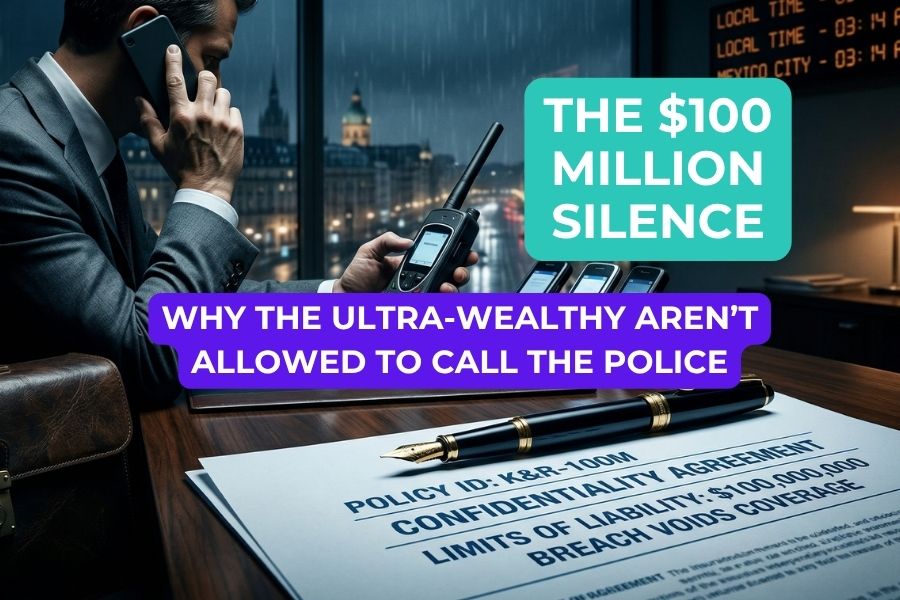
While most standard business policies cover between $1 million and $5 million, the world’s most elite insurers (like AXA XL or Chubb) offer specialized coverage up to $100 million for ultra-high-net-worth individuals and global corporations.
1. The “Invisible” Limit
A $100 million policy is the ultimate status symbol that nobody is allowed to talk about. The paradox is that having this much coverage makes you a “Golden Target.” If a kidnapping group knows you are insured for $100 million, they will never settle for $1 million. The “Silence” in the title refers to the fact that the insurance company can void the entire $100 million payout if you or your family leaks the existence of the policy.
2. The Cost of the “Ghost”
The $100 million doesn’t just cover the ransom. In these high-tier policies, a massive chunk of that limit is reserved for “additional expenses”, which can often outcost the ransom itself. This includes:
- Private Negotiators
Elite consultants who bill thousands per hour. - PR and Legal Teams
To keep the story out of the press and manage the “State” (police/government). - Forensic Investigators
To find out who leaked your travel plans. - Medical & Psychiatric Care
Long-term recovery for the victim and family.
The 100 million also echoes the rare, world-record ransoms that haunt the industry. For example, in the 1990s, the son of Hong Kong tycoon Li Ka-shing was released after a record-breaking ransom of approximately **$134 million** (HK1 billion). Policies at the $100 million level are designed to protect against these “Black Swan” events where a regular $5 million policy wouldn’t even cover the down payment.
We all have a price. For some, it’s just buried deeper in a corporate vault than others. Keep your eyes open and your circle small. ~ Foxella