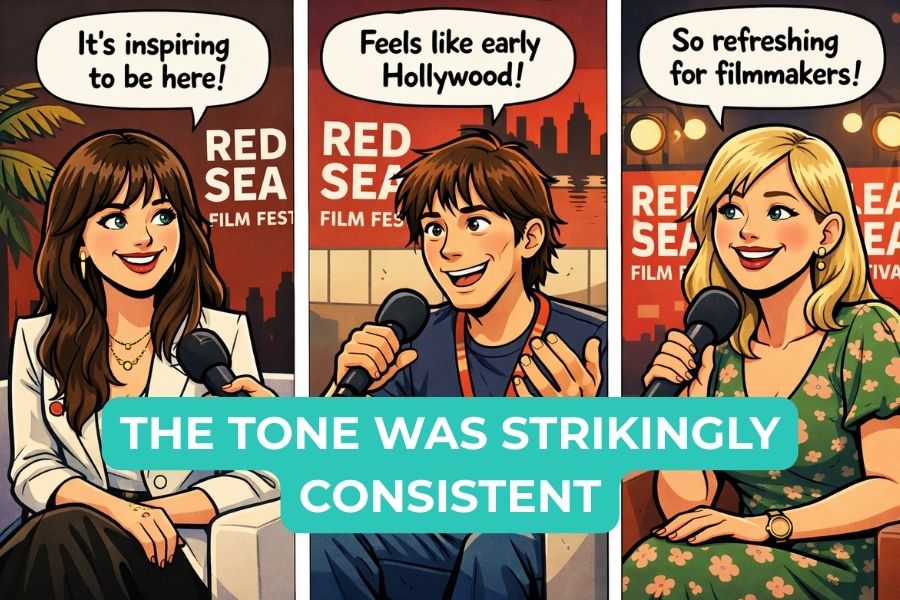
If you’re wondering why this 3 generation nepo baby/bad actress, the recent Oscar winner sex creep filmmaker, and the A list actress who has worked since she was a baby all attended and repeated the same talking points at this foreign born film festival in this controversial country, each of them were paid millions.
Blood money millions.
Dakota Johnson
Sean Baker
Kirsten Dunst
Red Sea International Film Festival
Hollywood’s relationship with Saudi Arabia is starting to sound like a shared script. As studios struggle with shrinking budgets, stalled productions, and an industry still trying to find its footing, Saudi-backed platforms like the Red Sea International Film Festival are being talked about in almost identical terms by the stars who attend. Opportunity. Optimism. A feeling of renewal.
In Jeddah, the tone was strikingly consistent.
Dakota Johnson was among the most candid. In her on-stage conversation, she described the U.S. film industry as bleak and heavy, weighed down by uncertainty and fatigue. But when she spoke about her experience at the festival, her mood shifted noticeably. She talked about feeling hopeful again, inspired by the resources being poured into filmmaking and the seriousness with which cinema is being treated. The contrast was clear. Hollywood feels stuck. Saudi Arabia feels energized.
That same contrast appeared again and again.
As jury president, Sean Baker echoed similar sentiments, even if his delivery was more upbeat. He praised the Saudi film scene as emotionally moving and full of momentum, emphasizing how rare it feels right now to encounter an industry that is actively growing instead of contracting. Like Johnson, Baker framed Saudi Arabia as a place where filmmakers are being listened to, funded, and encouraged rather than stalled by fear and financial hesitation. His comparison to the early days of Hollywood carried the same underlying message. This is where the energy is right now.
Then came Kirsten Dunst, whose interviews and panel appearances quietly reinforced the same narrative. Dunst spoke about longevity, creative survival, and how actors must adapt as the industry reshapes itself. Without explicitly endorsing any political narrative, she emphasized how refreshing it felt to be in a space where filmmaking was treated as culturally important rather than expendable. Her comments mirrored Johnson’s sense of exhaustion with the current Hollywood system while hinting at curiosity about what comes next.
Even the surrounding imagery reinforced the message. Dunst appearing alongside Jessica Alba and Ana de Armas on red carpets and in interviews sent a visual signal that the industry is paying attention. Not cautiously. Actively.
Taken together, the interviews formed a pattern. Hollywood insiders are openly admitting that the traditional system feels unstable, while Saudi-backed spaces are being described as hopeful, well funded, and creatively alive. Supporters see this as a natural evolution of global filmmaking. Critics argue it reflects how financial pressure can soften ethical boundaries.
Either way, the message coming out of Jeddah was consistent. When Hollywood talks about its future right now, Saudi Arabia is very much part of the conversation.